
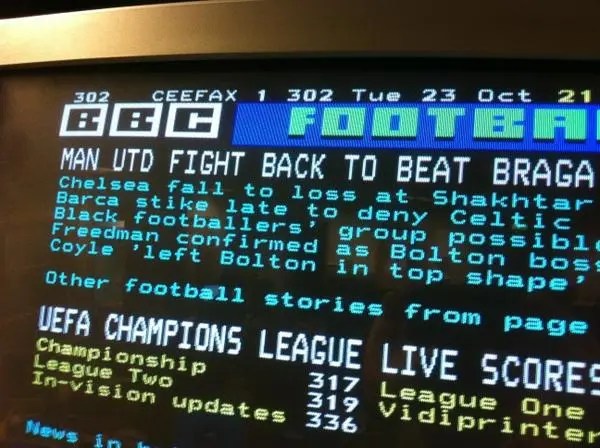
If you grew up following football before smartphones, you’ll know the strange, anxious joy of staring at a dark screen, waiting for a number to change. I’m talking, of course, about Ceefax—and its ITV cousin, Teletext.
For fans of a certain age, Ceefax wasn’t just a service. It was a ritual. It was Saturday afternoons in the living room, the remote control on the arm of the chair, and eyes glued to page 302.
The Pre-Internet Scoreboard
Before Sky Sports’ rolling updates, before live blogs and apps, football fans had limited ways to know what was happening elsewhere:-
- You might tune in to Sports Report on the radio.
- You might catch the vidiprinter on Grandstand.
- Or you could wait until the evening news or Sunday papers.
But Ceefax changed everything. With a few taps on the remote, the screen flickered, and suddenly you were connected to the wider football world—instantly, almost magically.


The Page 302 Ritual
The crown jewel for football fans was always page 302.
You’d type it in and wait, as the TV clunked into that familiar dark background. The Premier League (or Division One, depending on the era) was usually on the main page, and then you’d cycle through subpages for the lower leagues, Scotland, or the FA Cup.
It was never instant. Sometimes you’d just miss the page you wanted, and you’d have to sit there for what felt like hours (but was probably 30 seconds) for it to come back around. In those seconds of waiting, your heart could be pounding.
When the Numbers Changed
The thrill came when the numbers actually moved. Maybe your team had been trailing at half-time, and now—yes!—they’d pulled it level. Maybe you were nervously watching your rivals’ scoreline creep across the screen, hoping it stayed the same.
There was no flashy graphic, no ping on your phone, just a digit changing on a blocky screen. But somehow, that was enough to send you into ecstasy—or despair.
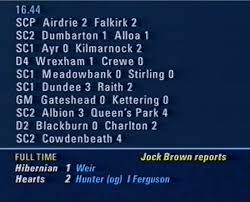
The Classified Results, Teletext-Style
The full-time scores page was something special. It mirrored the old radio classified readout:
No fuss, no fanfare, just pure information. Somehow, it felt weightier, more official, when you saw it on Ceefax.
Beyond the Scores
Ceefax wasn’t just for matchdays. It was part of the daily routine.
- Transfer gossip—long before Twitter rumours.
- Fixture lists for midweek games.
- Tables updated in real time, which felt like wizardry at the time.
- And of course, those pixelated graphics when a big tournament came around.
Breakfast time, weekday evenings, late-night scrolling—it became a habit, almost like checking your emails today.
The Charm of the Wait
Looking back, part of Ceefax’s magic was the waiting. You couldn’t scroll endlessly or refresh at will. You had to be patient.
That meant every update felt earned. Every goal arriving on screen had weight because you’d been sat there, nervously watching the page cycle by.
In a strange way, the slowness made the experience more memorable than today’s flood of instant alerts.
The Final Whistle
By the 2000s, the internet and mobile phones took over. Teletext on ITV closed in 2009. Ceefax carried on until 2012, when the digital switchover finally killed it off.
When Ceefax shut down, it felt like the end of an era—not just for television, but for football fandom.
Why We Still Miss It
Ask any fan who lived through it, and they’ll smile when you say “page 302.” They’ll remember nervously waiting for the screen to flicker, the joy of a single digit changing, the odd comfort of that blocky layout.
Ceefax wasn’t flashy, but it was reliable. It was part of the fabric of being a football fan. And though apps and websites give us far more today, nothing will ever replace that little thrill of watching the page turn.
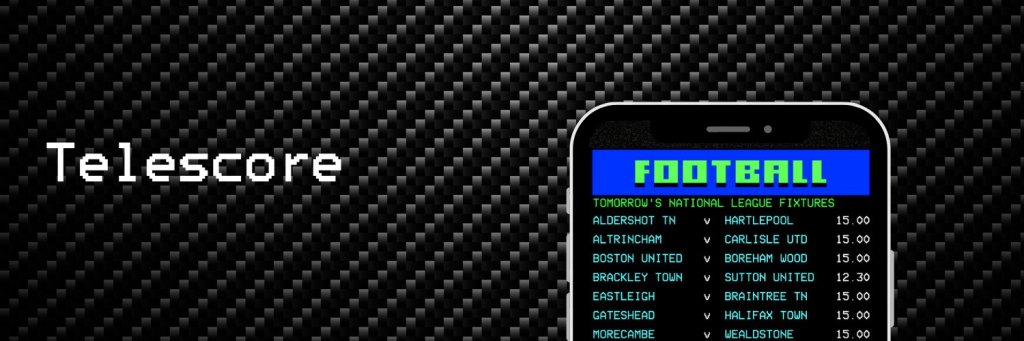
Ceefax maybe gone. But for those who waited, hoped, and cheered at a changing scoreline, it can be relived on the popular app Telescore

SHOP a huge range of retro classics at 3Retro.com

 thehexblog.com