

Championship footballers played a secret game in plain sight, if supporters ever discovered what was being passed around the pitch during certain Cardiff City matches in the 2010s, the outrage would have been instant. Not a note from the bench. Not tactical instructions. A coin!
A single 50p piece, quietly handed from teammate to teammate, right in the middle of a professional football match. This was not a training-ground prank or a post-season joke. It happened during competitive Championship fixtures. And somehow, Cardiff kept winning.
The story of the Cardiff City 50p game has lingered in dressing-room folklore for years, whispered between players and laughed about long after boots were hung up. It only truly came to light recently, when former Cardiff defender Lee Peltier explained it in detail on The Football Historian Podcast.

What makes it remarkable is not just that footballers were playing a game within a game, but that it happened under Neil Warnock – a manager famed for discipline, standards, and an iron grip on squad culture.

What exactly was the 50p game?
The rules were absurdly simple.
There was a coin – usually a 50p, though any coin technically worked.
One player would start with it.
From then on, at any moment, they could discreetly pass it to a teammate.
The catch?
You were not allowed to refuse it.
If a teammate handed you the coin, you had to take it.
Lee Peltier remembers it fondly.
“Yeah, great game. Absolutely great game,” he said, laughing, when asked if it really happened.
“You basically have a coin – it was 50p – and during the game you could pass it onto one of your teammates, but your teammate could not refuse you.”
The objective was survival.
Whoever had the coin at the end of the match was the loser. And the punishment? Dinner.
“By the time the end of the game comes, the last person with the coin had to pay for the meal,” Peltier explained.
This wasn’t a one-off novelty. Peltier played the game multiple times across his Cardiff career, which ran from 2015 to 2020. And he insists it only ever happened in the right circumstances.
“Usually towards the back end of the season when you’ve got nothing to play for,” he said.
“It doesn’t really affect a result or performance. As I say, we won both the times I’ve played it.”
That last line matters. Because if Cardiff had lost while the 50p was doing the rounds, the reaction would have been very different.
Playing games in the heat of competition
This is where the story crosses from amusing to almost unbelievable. These were not friendly matches or pre-season tours. These were Championship fixtures – one of the most physically demanding leagues in world football. The idea that players were thinking about a coin while tracking runners, defending corners, or chasing second balls feels absurd.
And yet.
Peltier recalls moments that sound like something from a Sunday league comedy sketch.
“I remember taking a throw-in and I’ve got it in my mouth,” he said.
“I’m taking the throw-in like that.”
In another moment, the coin reached the goalkeeper.
“Dave Marshall was in goal and it was a corner,” Peltier recalled.
“Someone passed the coin to him, so he put it next to his goalpost while he defended the corner.”
Once the danger was cleared, Marshall picked it up and sprinted after a centre-half.
“‘There you go!’”
The mental image alone explains why this story has endured. It also raises an uncomfortable question. What would fans have thought if they knew?
Supporters accept mistakes. They forgive bad days. But the idea that players were passing a coin around during a match would have been explosive – especially in defeat. Cardiff City won on both occasions the game was played feels significant. It allowed the story to remain a harmless piece of folklore rather than a scandal.
Michael Chopra and the wider Cardiff connection
The 50p game was not confined to one squad or one season.
Former Cardiff striker Michael Chopra – who played for the club between 2006 and 2011 – independently recalled the same game years later while speaking on Goalposts TV.
His reaction mirrored that of every fan who hears it for the first time.
Disbelief.
“Tell me right now that you used to play a game in Championship football standard and you’re all passing it around,” Chopra laughed.
He confirmed the same rules. You couldn’t refuse the coin. Whoever had it at half-time or full-time paid.
“Whoever’s left with it at the end has to buy the meal for the lads,” he said.
Chopra even joked about how it would work at set pieces.
“How would you pass it on a corner?”
The fact that players from different Cardiff eras recall the same game strongly suggests it wasn’t a one-season gimmick. It was a tradition that surfaced occasionally, passed down through dressing-room culture. Not every year. Not every squad. But enough to embed itself in club folklore.
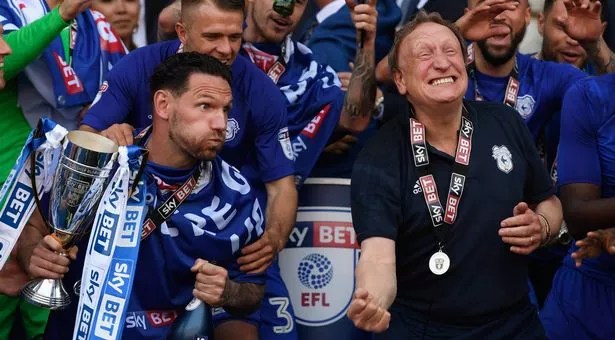
How this could happen under Neil Warnock?
This is where the story becomes more than just a funny anecdote because the Cardiff City 50p game happened during Neil Warnock’s time at the club. Warnock managed Cardiff from 2016 to 2019, overseeing promotion to the Premier League and building one of the tightest-knit squads in the club’s modern history.
On paper, he is the last manager you would expect to tolerate something like this. Old-school. Demanding. Uncompromising. And yet, this game existed on his watch.
Lee Peltier’s insight into Warnock’s management style explains why.
“He has three or four players that he goes through and then he will trust them to run the dressing room and leave them,” Peltier said on The Football Historian Podcast.
“He’ll just take care of everything else.”
Warnock’s authority did not come from micromanagement.
It came from trust.
“Even in terms of days off, families and doing stuff as a team, he just brings everyone together,” Peltier added.
“I remember sitting in changing rooms with him… you look around and you can see everyone’s ready to run through brick walls for him.”
That environment matters. A dressing room that feels trusted behaves differently. Players police themselves. They know when something crosses the line. The 50p game, played sparingly in dead-rubber matches, never did. That says everything about the culture Warnock built.
The fine line between fun and outrage
There is no escaping the uncomfortable truth. If Cardiff had lost one of those matches, this story would not be remembered fondly. It would be used as evidence of complacency. Of disrespect. Of players not taking the shirt seriously. Football culture is unforgiving in hindsight. Winning reframes everything. Losing exposes it.
The reason the 50p game remained secret for so long is partly down to results and partly down to the code of the dressing room. Certain stories only surface years later, when careers are over and the stakes are gone. This is one of them.
A game anyone can play
Part of what makes the 50p game resonate is how transferable it is. Strip away the stadium, the crowd, and the pressure, and it becomes something familiar. A social game. A bonding exercise. I know that first-hand. In 2024, on my stag do in Bulgaria, we played our own version. Instead of a coin, we passed around a small toy goat. Same rules. No refusals, if anyone sees you pass it – you must keep hold. Loser pays or drinks.
It worked just as well – a simple idea that creates chaos, laughter, and shared memory. The fact footballers were doing this in professional matches is what elevates the story from amusing to legendary.
Why stories like this endure
Football history is often told through trophies, goals, and promotions. But the stories fans remember most live elsewhere. In dressing rooms. On buses. In moments never shown on highlights reels. The Cardiff City 50p game survives because it reveals something human. Elite footballers, under immense pressure, still found room for humour. Still trusted each other. Still played.
It also survives because podcasts and social media now give space for these stories to be told properly. Lee Peltier explaining it in his own words brings it to life in a way a second-hand anecdote never could.
Keeping football folklore alive
Stories like this are exactly why The Football Historian exists. To preserve football’s unwritten history. To give former players the space to explain the moments fans were never meant to see. If you want to hear Lee Peltier describe the 50p game himself – including the throw-in moment and the goalkeeper sprint – the clip is available on The Football Historian Instagram.
The full conversation, along with countless other dressing-room stories, lives on The Football Historian Podcast, with extended discussions available via Patreon.
Football will always be about results. But its soul lives in stories like this. A coin. A dressing room. And a group of players who trusted each other enough to play a game inside the game.
Written by Peter Kenny Jones
The Football Historian
Instagram, Facebook, TikTok, YouTube

SHOP a huge collection of official retro classics at 3Retro.com

 thehexblog.com