
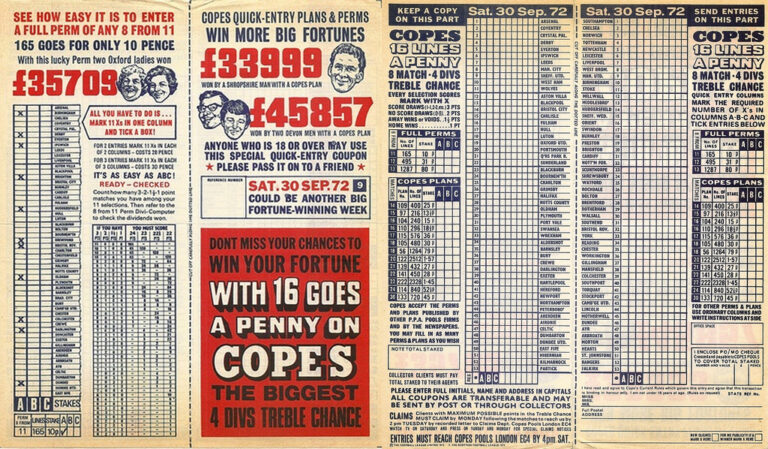
There is something wonderfully optimistic about a football supporter before kick off.
For all the evidence gathered during the week, all the injuries, poor form, tactical problems and memories of what happened the last time these two teams met, by three o’clock on a Saturday afternoon we have generally managed to convince ourselves that we know what is about to happen. We know who will win. We have a score in our head. We know which striker will score and, if we’ve put an accumulator on, we have somehow persuaded ourselves that several completely separate football matches are all going to behave exactly as expected on the same afternoon.
Usually, by five o’clock, football has reminded us that we know considerably less than we thought we did.
That hasn’t stopped us trying.
The history of football predictions is really part of the history of being a football supporter in Britain. It stretches back through bookmakers and betting coupons, the Littlewoods Pools coupon on the kitchen table, the Saturday accumulator, Fantasy Premier League and Super 6. It is also a history of how we followed football itself, from waiting for the Pink and listening for the classified results on Grandstand, to refreshing Teletext and, eventually, watching scores change instantly on the phone in your pocket.
The technology has changed beyond recognition. The argument hasn’t.
What’s the score going to be?
Before the Pools, We Were Already Betting on Football
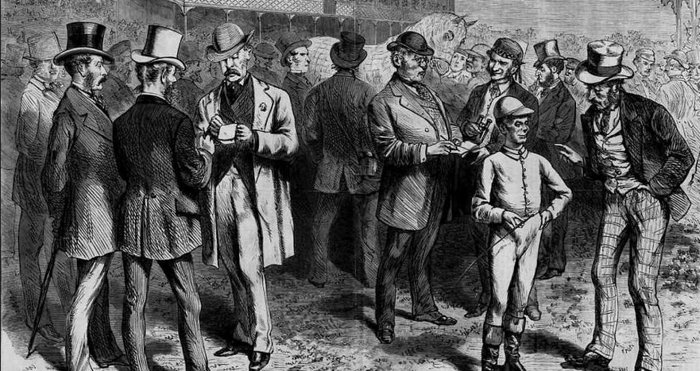
Football and gambling have been connected for almost as long as organised football has existed. Britain already had an established culture of betting around horse racing, boxing and other sports by the time professional football began attracting huge crowds in the late nineteenth and early twentieth centuries. As football’s popularity increased, so did the temptation to turn an opinion about Saturday’s match into a wager.
Football offered something particularly attractive. Supporters believed they possessed knowledge. This wasn’t simply picking a number or backing a horse because you liked its name. You watched the team. You knew the players. You had seen the opposition. You knew the centre forward hadn’t scored for a month, the goalkeeper was carrying an injury and that your team hadn’t won away there for years.
Surely all of that gave you an edge?
That idea, that knowing football means you should be able to predict football, has survived for more than a century. It remains one of the most seductive assumptions in the game.
There was also the sheer volume of football. Saturday afternoon offered an entire fixture list rather than a single event. Instead of predicting one outcome, supporters could attempt to predict several. That created the perfect conditions for the pools, the fixed odds coupon and, eventually, the accumulator. But it was during the 1920s that football prediction became something much bigger than a bet between a punter and a bookmaker.
Littlewoods Turns Football Prediction Into a National Obsession
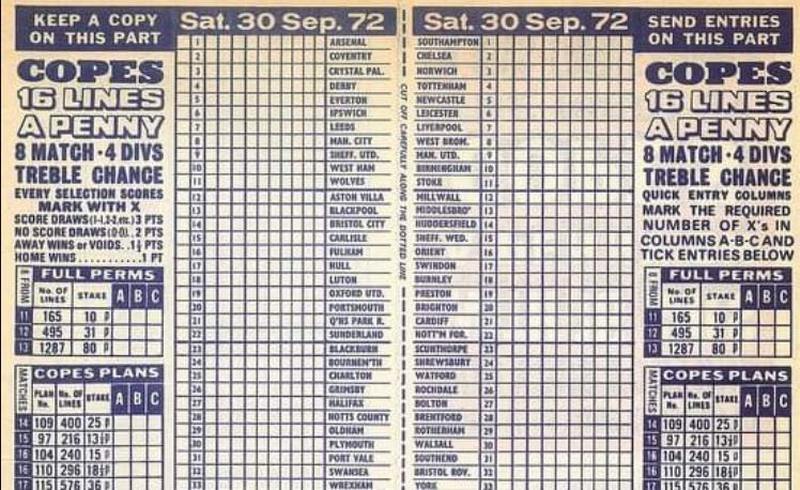
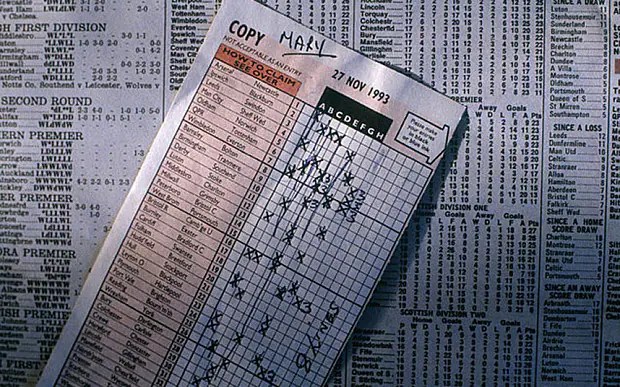

In 1923, John Moores, Colin Askham and Bill Hughes launched what would become the Littlewoods Football Pool in Liverpool. Its beginnings were hardly spectacular. The early coupons attracted little interest and the business might easily have disappeared before it had really started. Moores persisted, however, and what followed became part of British football history.
The football pools eventually became woven into the fabric of the weekend. Millions of people studied lists of fixtures, searching for the results that might transform an ordinary Saturday into something extraordinary. The famous Treble Chance was particularly associated with identifying score draws. It meant looking beyond your own club and attempting to understand matches taking place across the divisions. Some people studied form. Some developed systems. Some had favourite numbers. Others relied on instinct, superstition or little more than a hunch.
Whatever the method, the pools established something that would survive through every subsequent generation of football prediction. They gave supporters a reason to care about matches they might otherwise have ignored. A seemingly insignificant fixture hundreds of miles away could suddenly become the most important game in the country if it was the final result required on your coupon.
And then you had to discover what had happened.
The Pink, Grandstand and Waiting for the Scores
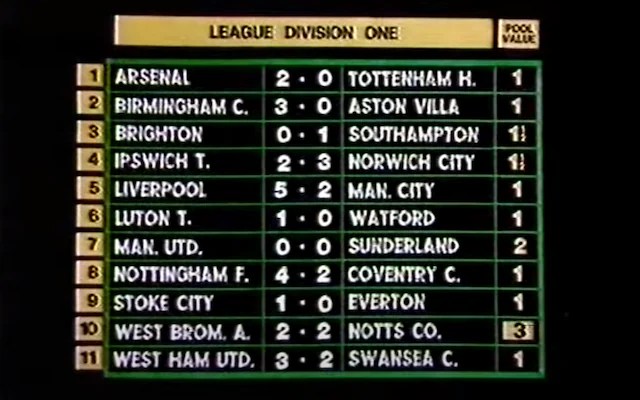

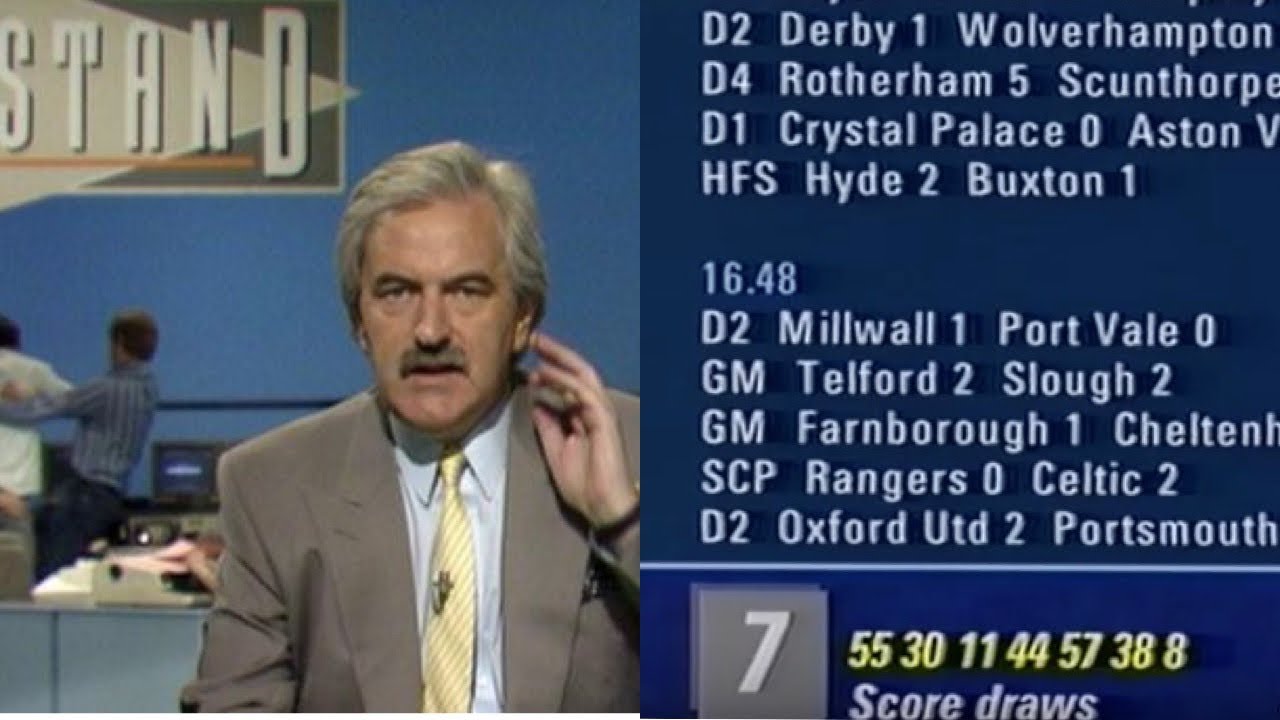
For supporters who have grown up with smartphones, it is difficult to explain quite how different following Saturday afternoon football once was.
Today, a goal can happen hundreds of miles away and appear on your phone seconds later. Apps update automatically, social media reacts immediately and live league tables change as the ball hits the net.
Earlier generations had to wait. The Saturday Pink became part of football culture, printed after the afternoon’s matches, the sports paper carried reports, scores and tables while the day’s football was still fresh. For supporters who had filled in a pools coupon or placed a bet, getting hold of the latest results was part of the Saturday ritual.
Television created another. For generations of football supporters, BBC Grandstand and Final Score provided the soundtrack to late Saturday afternoon. Results arrived from grounds around the country, appearing on the vidiprinter screen before the classified football results were read aloud. There was something almost ceremonial about it.
“Arsenal two, Aston Villa one…”
If you were checking a pools coupon or a football bet, every result potentially mattered. A match in the lower divisions could suddenly be every bit as important as what had happened at Old Trafford, Anfield or Highbury. The pace of it was completely different from modern football. You couldn’t immediately skip ahead and discover whether you’d won. Results emerged one after another. Hope survived, grew and occasionally disappeared as another score was announced. Football prediction wasn’t just about making your selections. Waiting to discover whether you’d been right was part of the experience.
From the Pools Coupon to the Betting Shop
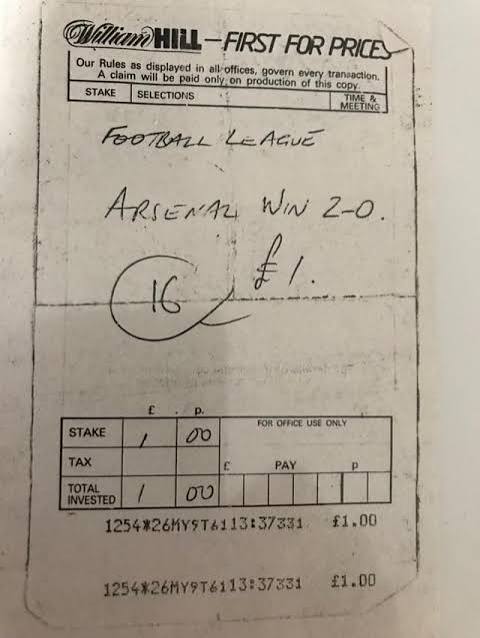

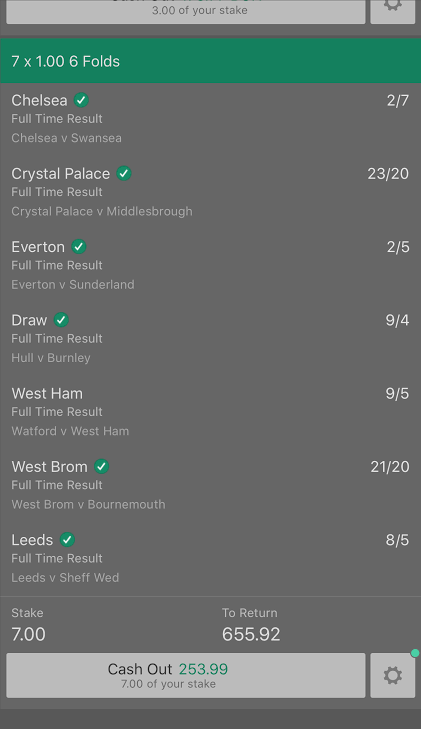
The pools remained enormously popular, but football betting continued to evolve. Fixed odds coupons gave supporters another way of applying their supposed knowledge. Instead of concentrating on combinations of draws, you could study the fixture list and decide who you thought would win.
The betting shop eventually became another familiar feature of British football culture. Saturday morning could involve studying the coupon, looking for the obvious home victories and attempting to identify where the bookmaker might have got something wrong.
Of course, the bookmaker had one fairly significant advantage. It was their business to get these things right. Football supporters, however, have never lacked confidence. And gradually one particular type of bet became synonymous with the football weekend.
The Saturday Acca
The accumulator, or acca, was irresistible because it turned a collection of apparently sensible predictions into the possibility of a much bigger return. Manchester United at home looked safe. Liverpool should win. Arsenal were in form. Chelsea couldn’t possibly lose to the team at the bottom. Add another favourite. Then another. Suddenly a relatively small stake was promising a very attractive return.
The problem was that football matches don’t know they’re supposed to be part of your accumulator. Almost everybody who regularly played accas has a story. Seven teams won and the eighth conceded an equaliser in injury time. The goalkeeper saved a penalty. A striker missed an open goal. A team everyone considered unbeatable somehow drew 0-0. The accumulator reinforced one of the central contradictions of football prediction. Every individual selection can make complete sense, yet combining them exposes just how unpredictable football really is.
It also changed the relationship between prediction and football. With an accumulator, the bookmaker was firmly in the middle. Get the predictions right and you might win. Get them wrong and the bookie keeps the stake.
Teletext Changes the Saturday Results Ritual
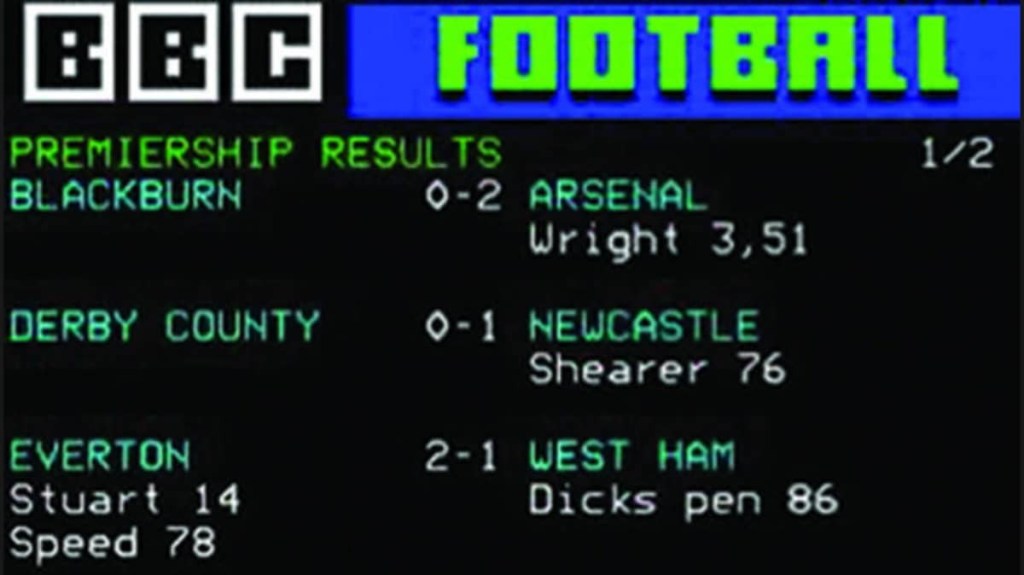
Then came another piece of technology that an entire generation of football supporters remembers with enormous affection. Teletext.
For younger supporters, trying to explain the excitement of staring at blocky coloured text on a television screen probably sounds ridiculous. For those who experienced it, it made perfect sense. Football scores, league tables and news were suddenly available through the television. You didn’t necessarily have to wait for the Pink or the classified results. You could enter the page number and see what was happening.
Or at least what had been happening the last time the page updated.
Anyone checking a football coupon or accumulator knew the experience of seeing a match apparently stuck at 1-0 and wondering whether the game was still being played or whether Teletext simply hadn’t refreshed yet. There were no push notifications, live animations or goal alerts. Just the screen and the hope that the next update would bring good news. Or if like me you’d be listening to the live game on radio whilst watching Teletext refresh on loop hoping for the latest score updates.
Teletext represented another stage in the gradual shortening of the gap between something happening at a football ground and supporters discovering what had happened. It’s been recreated excellently recently via the Telecore APP. However, the internet would eventually eliminate that gap almost completely.
The Internet Makes Football Prediction Social
Once football moved online, prediction began to change again. The internet didn’t simply make results quicker. It allowed supporters to compete with each other much more easily. Football forums created prediction leagues. Newspapers moved competitions online. Workplaces no longer needed somebody keeping everybody’s scores in a notebook or spreadsheet. Groups of friends could run private competitions across an entire season.
And the motivation began to change. Money didn’t necessarily have to be involved. Sometimes the prize was simply being able to prove you knew more than your mates. Anyone who has spent a season in a football prediction league understands that perfectly. Winning something is nice. Spending the next six months reminding everyone that you finished above them can be considerably more satisfying.
Then football prediction took another enormous leap. Instead of predicting teams, we started predicting players.
Fantasy Premier League Turns Us All Into Managers

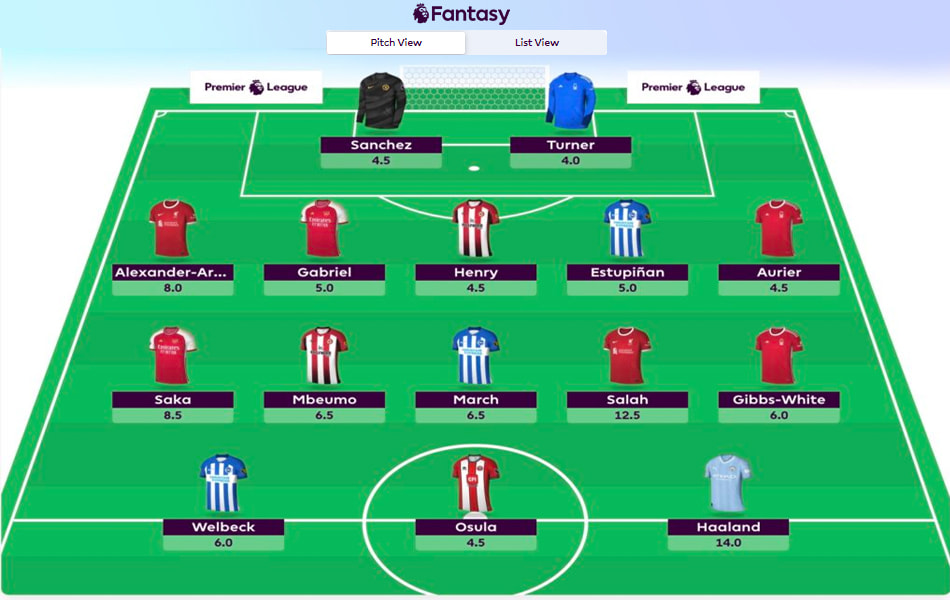
Fantasy football had existed in different forms before the internet, but the launch of the official Fantasy Premier League in the early 2000s helped transform it into a phenomenon.
FPL asked a completely different set of questions. Would the striker score? Would the defender keep a clean sheet? Would the midfielder get an assist? Who should be captain? Was it worth making a transfer?And why did the player you transferred out on Friday inevitably score twice on Saturday?
Fantasy football changed the way supporters watched matches involving clubs they didn’t support. A Manchester United supporter could find themselves wanting an Arsenal midfielder to score because he was in their fantasy team. A Liverpool fan might desperately want Manchester City’s goalkeeper to keep a clean sheet.
It also helped create a much more statistically aware generation of supporters. Minutes played, fixture difficulty, expected goals, set pieces, assists and underlying performance data increasingly became part of everyday football conversation. The supporter wasn’t simply watching football anymore. They were analysing it. But FPL wasn’t really a football score prediction competition. You could be brilliant at Fantasy Premier League without ever predicting a single match score. There was still room for something simpler.
Super 6 Brings Back the Correct Score

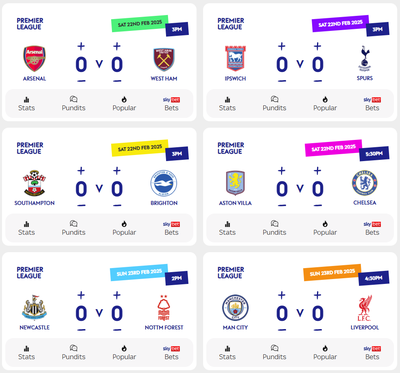
Sky Sports Super 6 returned to one of the oldest and simplest challenges in football. Predict the score.
Six matches are selected and players attempt to correctly predict the score of each. Its simplicity is a major part of the appeal. There are no fantasy squads to manage and no complicated betting markets to understand. You’re given six fixtures and asked what you think the scores will be. But the name also identifies its limitation.
Six.
You’re predicting six selected matches. That’s an entertaining challenge, but it isn’t a complete test of somebody’s ability to predict football over a season. The biggest televised fixtures aren’t necessarily the matches that really test your knowledge. Everyone has an opinion on Manchester City against Liverpool or Arsenal against Manchester United. Sometimes the difficult prediction is the seemingly ordinary game between two mid table teams on a wet Saturday afternoon. And that’s where there was still a gap.
From Six Games to Every Game

The evolution of football prediction has given supporters plenty of different ways to test their knowledge.
The pools asked them to identify combinations of results. The bookmaker gave them fixed odds and the Saturday accumulator. Fantasy Premier League asked them to predict which individual players would perform. Super 6 brought the correct score back to the centre of the game, but restricted the challenge to six selected fixtures. There was still a simple question nobody had really answered.
What if you could predict every match involving a Premier League team?
Not simply the ten matches from a normal Premier League weekend, but the Tuesday, Wednesday and Thursday nights too. That’s the space PlayPredictWin is designed to fill. Throughout the season, players can predict every Premier League fixture as well as matches involving Premier League clubs in the Champions League, Europa League, Conference League, FA Cup and League Cup. When club football pauses for an international break, selected key international fixtures are included too.
It creates a much broader test of football knowledge. One week you might be predicting Manchester City against Liverpool in the Premier League. A few days later it could be Arsenal away in the Champions League, Aston Villa in Europe, Manchester United in the League Cup or England in an important international.
The headline matches matter, but so do the awkward ones. Predicting six selected games gives you a snapshot of how good your predictions were that week. Predicting match after match, competition after competition, across an entire football season begins to create something much more interesting.
A record. And unlike the traditional accumulator, there is another fairly significant difference.
PlayPredictWin is completely free to play.
There is no stake to lose and no bookmaker benefiting when your confident 2-1 prediction finishes 1-1. You’re not trying to beat the bookies. You’re trying to beat everyone else.
Three Points for the Score, One Point for the Result
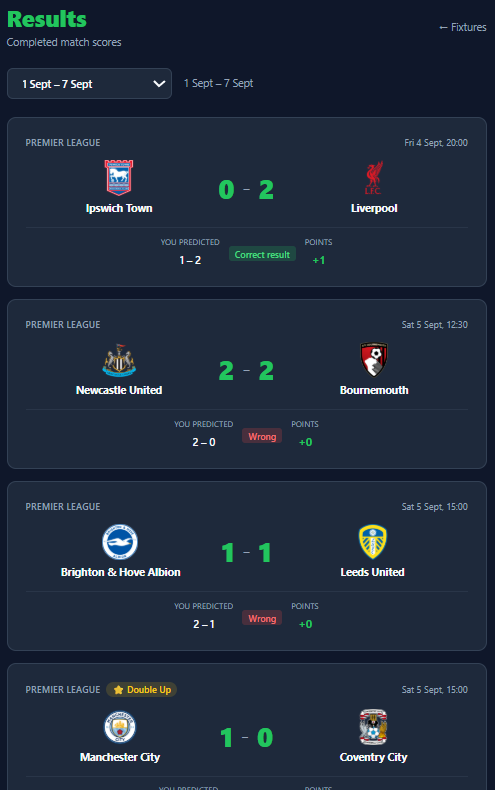
The PlayPredictWin scoring system should immediately make sense to anybody who understands a football league table. Predict the exact score and you receive three points. Get the result right, a home win, away win or draw, but not the exact score, and you receive one point. Get it wrong and you receive nothing. The idea deliberately follows football’s familiar scoring principle, three points for a win and one point for a draw. It keeps things simple.
You don’t need to understand fractional odds, decimal odds, handicaps, goals markets or any of the terminology surrounding modern football betting. You simply have to answer the question supporters have been answering for generations.
What’s the score going to be?
There is also a Double Up selection, allowing players to choose a fixture where they feel particularly confident and potentially double the points earned from that prediction. Over one weekend, luck can play a considerable role. We’ve all confidently predicted a routine 2-0 win only to watch someone who knows virtually nothing about either team randomly choose 3-3 and somehow get it exactly right. That’s football.
Stretch the competition across Premier League weekends, European nights, domestic cup ties and international fixtures, however, and consistency becomes increasingly important. Eventually it stops answering the question, “Who got lucky this weekend?” It starts answering a much better one.
Who actually knows football?
A Football Prediction Game Without the Bet
Perhaps this is where the journey from the football pools to PlayPredictWin becomes particularly interesting. For much of the last century, predicting football and gambling have been closely connected. The pools required a stake. The fixed odds coupon required a stake. The Saturday acca requires a stake. Modern betting apps have simply made placing that stake considerably easier. PlayPredictWin separates the prediction from the bet.
There is no need to deposit money before you can demonstrate what you know about football. There is no bookmaker’s margin to overcome and getting a prediction wrong doesn’t mean somebody else keeps your stake.
It’s free.
That changes the motivation. Instead of asking, “Can I beat the bookie?”, the question becomes, “Can I beat other football fans?” Can you beat your mates? Can you finish above the experts? Can your club’s supporters outperform those of your biggest rivals? Can you consistently predict matches across the Premier League, Champions League, Europa League, Conference League, FA Cup, League Cup and international football? And can you do it over an entire season rather than six selected matches on one Saturday?
Which Club Really Has the Most Knowledgeable Fans?
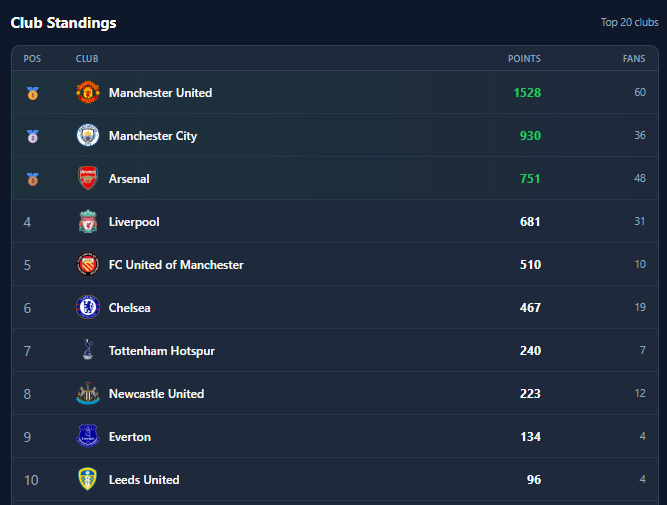
Every football club believes its supporters know the game. PlayPredictWin’s Supporter League gives us an interesting way of beginning to put that claim to the test. Players select the club they support and their prediction points contribute to that club’s performance. Looking simply at total points, however, doesn’t tell us very much because clubs with more players naturally have an advantage.
A much more interesting measure is average points per supporter. That allows us to start comparing how accurately different groups of supporters are actually predicting matches rather than simply counting which club has attracted the most players. There is an important caveat. Sample sizes matter enormously. A club represented by ten supporters can’t yet be fairly compared with one represented by hundreds or thousands. The numbers become much more meaningful as participation grows and more matches are predicted. But that’s also what makes the idea interesting.
Over time, thousands of predictions could provide a fascinating dataset for one of football’s favourite arguments. Which club really does have the most knowledgeable fans?
Are We Blinded by Our Own Colours?
There is an even more interesting question hidden inside all those predictions. What happens when supporters predict their own team? Football support is emotional. Prediction, theoretically at least, should be rational. The two don’t always sit comfortably together.
Imagine your club has lost three consecutive matches and is about to play the league leaders away from home. Every statistic suggests defeat.
Can you actually bring yourself to predict it?
Does a Manchester United supporter predict United victories more frequently than neutral supporters do? Are Liverpool supporters more optimistic about Liverpool? Do Everton supporters predict Liverpool defeats more frequently than everyone else? Would a Tottenham supporter happily predict an Arsenal victory when every piece of evidence suggested Arsenal should win?
We all like to think we’re objective about football. We’re probably not. Loyalty, rivalry, recent memories and simple optimism influence the way supporters see matches. With enough predictions, that becomes measurable. Instead of asking supporters whether they’re biased, you can look at what they actually predicted.
Do the Experts Really Know More Than the Fans?
There is another football assumption worth testing. Experts should be better at predicting matches.
Shouldn’t they?
Former professional footballers understand the game at a level most supporters will never experience. Journalists spend their working lives around clubs. Analysts study enormous quantities of data. Pundits are paid to explain what is happening. Surely they should comfortably outperform somebody predicting matches from the sofa?
Maybe.
The problem with pundit predictions is that we tend to remember the spectacular successes and forget the failures. Someone correctly predicts an unlikely score and the clip gets shared. Their completely wrong predictions from the previous few weeks disappear. A consistent scoring system changes that.
Everyone predicts the same matches. Everyone gets three points for an exact score and one for the correct result. Nobody gets extra points because they played 500 professional matches. Nobody gets a bonus because they’re a television pundit. Over a season, we can compare everyone on the same terms. Perhaps the experts will dominate. Perhaps ordinary supporters will surprise them.
Perhaps the real conclusion will be that after more than a century of trying, none of us understands football quite as well as we think we do.
From the Pink to the Smartphone
That might be the most interesting thing about the whole journey. Think about the supporter filling in a Littlewoods coupon generations ago. They made their selections, waited for Saturday, followed whatever information they could find and eventually discovered the results through the radio, the Pink or Grandstand.
The next generation had the betting shop and the Saturday acca. Then came Teletext. Then the internet. Then Fantasy Premier League. Then Super 6. Today a goal can happen hundreds of miles away and appear on the phone in your hand almost instantly.
We have more statistics, more information and more analysis than any football supporters in history. Yet the fundamental challenge hasn’t changed at all. Someone can give you every statistic imaginable. Eventually you still have to make a decision.
What’s the score going to be?
PlayPredictWin is simply the latest chapter in a football obsession that stretches back generations. Except this time there’s no coupon to hand in, no betting slip to lose and no bookmaker waiting to collect your stake. It’s free. Make your predictions. Represent your club. Compete with your mates.
Then, when someone tells you they know more about football than you do, you might finally have something more convincing than an argument in the pub to prove it.

Frequently Asked Questions
What is the best football prediction website?
The best football prediction website depends on what you want from it. Some websites provide football betting tips and tell users what somebody else thinks will happen. PlayPredictWin takes a different approach. You make the predictions yourself, earn points and compete against other supporters in a free football prediction league.
Is there a free football prediction league?
Yes. PlayPredictWin is free to play, with players predicting matches involving Premier League clubs and selected international fixtures. There is no entry stake, so supporters can test their football knowledge without placing a bet.
How do you predict a football match correctly?
There is no guaranteed way to predict a football match correctly. Recent form, home and away performance, injuries, suspensions, expected line ups, fixture congestion, previous meetings and underlying statistics can all help inform a prediction, but the unpredictable nature of football means no method can guarantee a result.
Can you win prizes predicting football scores?
Yes. PlayPredictWin gives supporters the opportunity to compete for prizes by predicting football scores without having to pay to enter.
What are correct score predictions?
A correct score prediction means forecasting the exact final score of a football match. On PlayPredictWin, predicting the exact score earns three points. Predicting the correct result but not the precise score earns one point.
Where can I find Premier League predictions?
There are numerous websites publishing Premier League predictions and football tips. PlayPredictWin works differently because rather than following somebody else’s predictions, players submit their own and see how their football knowledge compares with other supporters.
Can I predict Champions League matches for free?
Yes. PlayPredictWin includes Champions League fixtures involving Premier League clubs, alongside Premier League, Europa League, Conference League, FA Cup and League Cup matches.
Does PlayPredictWin include Europa League and Conference League predictions?
Yes. When Premier League clubs are competing in the Europa League or Conference League, their matches are included for players to predict.
Does PlayPredictWin include FA Cup and League Cup predictions?
Yes. PlayPredictWin isn’t limited to league matches. FA Cup and League Cup matches involving Premier League clubs are also included.
Does PlayPredictWin include international football predictions?
Selected key international matches are included during international breaks, giving players football to predict when the Premier League pauses.
What are football predictions today?
Football predictions today is commonly used when searching for forecasts for matches taking place that day. These can include predicted results, correct scores or betting tips. PlayPredictWin reverses the usual approach by asking supporters to make their own predictions and then scoring them according to their accuracy.
What are free football tips?
Free football tips are usually predictions or betting selections published without charge. PlayPredictWin isn’t a football tipping service. Instead of telling supporters what to predict, it challenges them to make their own selections.
What are acca tips?
Acca tips, short for accumulator tips, are several betting selections combined into one wager. Usually every selection needs to be successful for the bet to win. PlayPredictWin is different because there is no stake and it is free to play.
What are half time/full time predictions?
Half time/full time predictions forecast both the result at half time and the result at the end of a match. PlayPredictWin instead focuses on predicting the final score.
What’s the difference between Super 6 and PlayPredictWin?
Super 6 asks players to predict six selected football matches. PlayPredictWin includes every match involving Premier League clubs across the Premier League and domestic and European cup competitions, alongside selected international matches, creating a much broader season long prediction challenge.
Is PlayPredictWin a betting site?
No. PlayPredictWin is a free football prediction game rather than a bookmaker. Players don’t need to stake money on their predictions. The objective is to score points, compete against other supporters and win prizes.
Can you really predict a sure win today?
There is no such thing as a guaranteed football result. Red cards, injuries, individual mistakes, refereeing decisions and countless other variables can change a match. Claims of guaranteed or “sure wins today” should therefore be treated cautiously.
Can I create a football prediction league with my friends?
Yes. PlayPredictWin includes private leagues, allowing friends, families, colleagues and groups of supporters to compete against each other while also participating in the wider competition.


